This complimentary course is designed to provide you a curated list of essential books that delve into various topics of interest. These resources will enhance your understanding of key concepts, algorithms, programming practices, and system architecture, allowing you to explore areas that resonate with your personal and professional goals.
Key Books Covered:
-
The Unix Programming Environment:
- A classic resource that offers timeless insights into Unix programming, emphasizing the philosophy and tools of the Unix environment.
-
The Linux Command Line: A Complete Introduction:
- A modern guide that introduces the Linux command line, providing practical skills for navigating and utilizing Linux systems effectively.
-
TCP/IP Illustrated Series:
- A comprehensive series that explores the TCP/IP protocol suite, offering in-depth explanations and illustrations to enhance your understanding of networking concepts.
-
Head First Design Patterns:
- A gentle introduction to design patterns, using engaging visuals and real-world examples to make complex concepts accessible and relatable.
-
Design Patterns: Elements of Reusable Object-Oriented Software (Gang of Four):
- The canonical book on design patterns, providing a thorough exploration of reusable object-oriented design principles and patterns.
-
Algorithm Design Manual (Skiena):
- A dual-purpose book that serves as both a textbook on data structures and algorithms and a comprehensive algorithm catalog. It includes practical insights from the author's experiences in industry and academia, along with code examples in C.
-
Algorithm (Jeff Erickson):
- A well-regarded text that covers fundamental algorithms and data structures, providing a solid foundation for understanding algorithmic principles.
-
Write Great Code: Volume 1: Understanding the Machine:
- Although somewhat outdated, this book offers valuable insights into computer architecture and programming concepts, with chapters covering numeric representation, binary arithmetic, memory organization, and more.
-
Introduction to Algorithms (CLRS):
- A widely used reference for algorithms and data structures, this book is essential for understanding algorithmic principles, though it may not teach practical coding skills directly.
-
Computer Architecture, Sixth Edition: A Quantitative Approach:
- A comprehensive and up-to-date resource on computer architecture, providing a detailed examination of modern architectural concepts and quantitative analysis.
By engaging with these texts, participants will deepen their knowledge of computer science and gain valuable insights into various topics. This course
- Teacher: Zaien Aji Trahutomo
This course provides an in-depth exploration of advanced topics in computer science, designed for students and professionals seeking to enhance their understanding of complex algorithms, data structures, and system architecture. Participants will engage with a diverse range of subjects that are critical for mastering modern computing and software development.
Key Topics Covered:
-
Recursion and Dynamic Programming:
- Understand the principles of recursion and its applications in problem-solving.
- Learn dynamic programming techniques to optimize recursive solutions and tackle complex computational problems efficiently.
-
Design Patterns:
- Explore common design patterns in software engineering, including their purposes and best practices.
- Gain insights into how design patterns can improve code maintainability, scalability, and collaboration in software projects.
-
Combinatorics and Probability:
- Delve into combinatorial techniques and probability theory, focusing on their applications in algorithm analysis and decision-making processes.
-
Complexity Theory:
- Discuss the concepts of NP, NP-complete, and approximation algorithms, providing a foundational understanding of computational complexity and its implications for problem-solving.
-
Computer Architecture:
- Learn how computers process programs, including the roles of cache, processes, and threads, and their impact on system performance and efficiency.
-
Software Testing:
- Cover the principles and methodologies of software testing, emphasizing techniques for ensuring code quality, reliability, and robustness in software applications.
-
String Searching and Manipulations:
- Explore algorithms for efficient string searching and manipulation, including the use of data structures like tries for advanced string handling.
-
Floating Point Numbers and Unicode:
- Understand the representation and manipulation of floating-point numbers, as well as the significance of Unicode encoding in modern programming.
-
Endianness:
- Discuss the concepts of endianness in data representation, its implications for data processing, and its relevance in computer architecture.
-
Networking Fundamentals:
- Introduce basic networking concepts and protocols, highlighting their importance in computer science and software development.
By the end of this course, participants will have a comprehensive understanding of advanced computer science concepts, equipping them with the skills necessary to tackle complex problems in software development and system design. This course is ideal for computer science students, software engineers, and professionals looking to deepen their knowledge of advanced computing topics.
- Teacher: Zaien Aji Trahutomo
This course offers an in-depth exploration of graph algorithms, essential for solving complex problems in computer science, data analysis, and network design. Participants will learn about various types of graphs, fundamental concepts, and a range of algorithms used to traverse, search, and manipulate graph structures.
Key Topics Covered:
-
Introduction to Graphs:
- Understanding graph theory fundamentals, including definitions, terminology, and types of graphs (directed, undirected, weighted, unweighted).
- Representation of graphs using adjacency lists, adjacency matrices, and edge lists.
-
Graph Traversal Algorithms:
- Depth-First Search (DFS): Implementation, applications, and complexity analysis.
- Breadth-First Search (BFS): Implementation, applications, and complexity analysis.
- Comparison of DFS and BFS in various scenarios.
-
Shortest Path Algorithms:
- Dijkstra’s Algorithm: Finding the shortest path in weighted graphs.
- Bellman-Ford Algorithm: Handling graphs with negative weights.
- Floyd-Warshall Algorithm: All-pairs shortest path solution.
-
Minimum Spanning Tree (MST):
- Understanding the concept of minimum spanning trees.
- Prim’s Algorithm: Step-by-step implementation and applications.
- Kruskal’s Algorithm: Union-Find data structure and its role in MST.
By the end of this course, participants will have a solid understanding of graph algorithms and their applications, enabling them to tackle complex problems in various domains. This course is ideal for computer science students, software engineers, data scientists, and anyone interested in enhancing their algorithmic problem-solving skills.
- Teacher: Zaien Aji Trahutomo
This course provides a comprehensive exploration of sorting algorithms, focusing on their implementation, efficiency, and stability. Participants will gain a deep understanding of various sorting techniques, their best, worst, and average case complexities, and their applicability to different data structures such as arrays and linked lists.
Key Topics Covered:
-
Sorting Algorithms Overview:
- Introduction to sorting algorithms and their importance in computer science.
- Detailed analysis of common sorting algorithms, including:
- Merge Sort
- Quicksort
- Heapsort
- Insertion Sort and Selection Sort
- Bubble Sort
-
Stability in Sorting Algorithms
-
Data Structures
-
Advanced Topics:
- Introduction to Radix Sort and its linear time complexity under certain constraints.
- Exploration of randomization techniques in sorting.
-
Practical Implementations
-
Video Lectures and Resources
By the end of this course, participants will be equipped with the knowledge and skills to implement and analyze sorting algorithms effectively, making informed decisions on the best sorting techniques for various applications. This course is ideal for computer science students, software developers, and anyone interested in enhancing their understanding of algorithmic efficiency.
- Teacher: Zaien Aji Trahutomo
Learn to build and understand essential data structures with hands-on coding.
What you’ll cover:
- Arrays & Linked Lists
- Stacks & Queues
- Trees & Binary Search Trees
- Hash Tables
Implementation from scratch
This is a foundational topic every developer should master to write efficient and scalable code.
- Teacher: Zaien Aji Trahutomo
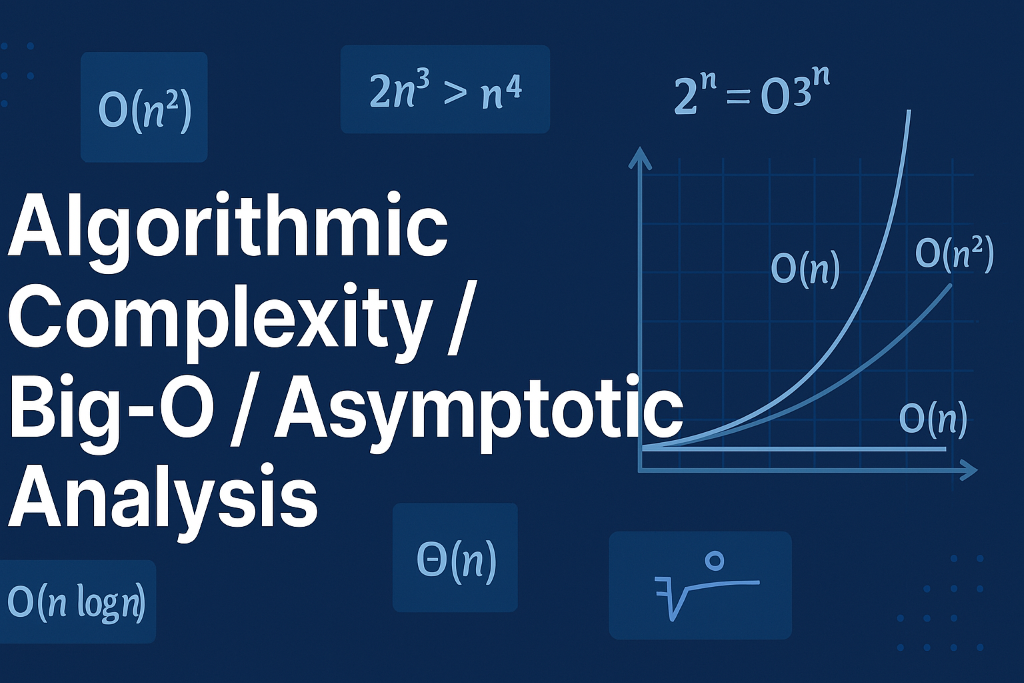
Understanding how your code performs is just as important as writing it correctly. This course introduces you to the essential concepts of algorithmic complexity, helping you evaluate and express the efficiency of algorithms using Big-O notation and its related forms (Omega and Theta).
This is a light, video-based course — no coding required. Just watch the content at your own pace, take notes, and build intuition. Don't worry about grasping every bit of math; focus on developing the ability to reason about algorithm performance.
Once you’re familiar with the concepts, reinforce your knowledge through the dedicated chapter and quiz in Cracking the Coding Interview.
By the end, you’ll be able to read, analyze, and discuss algorithms confidently using the language of complexity.
- Teacher: Zaien Aji Trahutomo
In this lecture, Dr. Bell introduces the theory of computation and explains some aspects of computational thinking. Programming languages are discussed, with an emphasis on basic Python syntax and data structures.
- Teacher: Zaien Aji Trahutomo